Today I walked amidst a millennium of Dutch historical artifacts at the Rijksmuseum.
Old school handcuffs…they’d catch criminals around the neck.
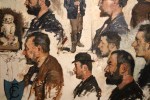
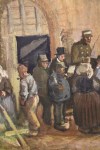
Water is a very obviously reoccuring theme in the museum. Many of the artifacts give testimony to the Netherlands difficult relationship with water. There was a painting from the 1500s showing the effects of the St. Catherine’s Day flood that devastated Dordrecht. There were countless paintings of dikes, polders, and windmills. Walking through the museum was like seeing the history of the Netherlands in a chest and many of the items had to do with water.
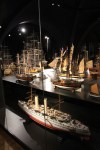
The museum was just recently reopened after closing for a major renovation in 2004. The building could be more impressive than any single work of art in the building. In the basement, where the special collections of medieval artifacts, weapons, and ship models, the interior is designed dark and cavernous resembling drafty damp dungeons and evoking an essence of the middle ages. The lobby is a modern atrium that is exuberantly filled up with light that reflects off the marble surfaces. Outside are gardens, cafes, and sculptures. Here’s a drawing I did of a man investigating a Henry Moore statue.
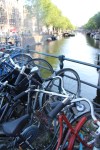
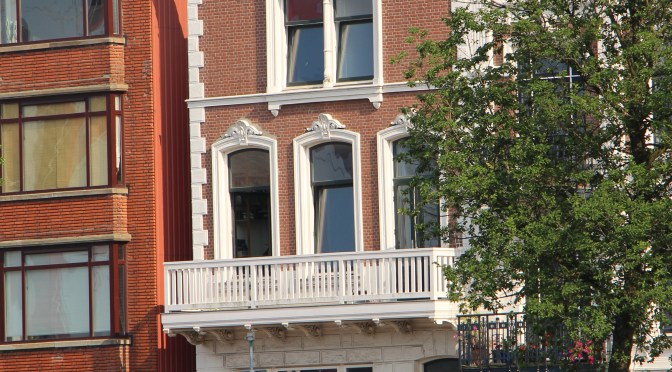
I was biking along one of the canals, just cruising, when I came upon this.
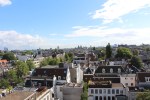
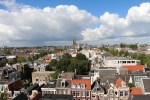
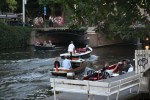
The first thing that caught my eye was the dumpy boat with the windsurf boards. As I investigated the building in the background, I recognized the words on the top floor, Felix Meritis. Only a few hours earlier I had seen a few group portraits of members of the Felix Meritis, an old social club for Amsterdam’s upper middle class. Back in the late 18th century, when there was still nobility in the Netherlands the Netherlands was no longer a global power, but it was still a rich country from maritme trade and wealth was distributed quite evenly. Members of the upper middle class would join this group, which translates to mean ‘happy by merit’ to talk about art, science, international trade and so on.
After I made the connection between the painting and this building, I rode my bike to the next canal bridge, parked my bike at front and pushed on the big wooden door. It slid heavily open into a reception area. It turns out, since the social group was dissolved, the building has been renovated and is now used for gatherings and private functions. There was a woman there who took me up onto the roof and gave me a brief tour. It was pretty special!
For the rest of the day I continued to bike around, explore, eat a burrito, take some photographs, and made this drawing:
I also found an awesome bookstore and subsequently discovered a great book on the urban history of Amsterdam. I have a lot of questions about the development of the canals so hopefully I’ll be able to dig through it for some answers.
Here is a drawing of the North Holland sea-dike. The primary coastal defense along the North West beach of North Holland where there are no naturally existing sand dunes to protect the low-lying fields from storm surges.
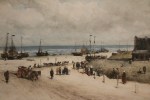
Here’s a painting about the Dutch project to widen the river, increase flood plains, and engineer the landscape specifically to allow space for the river to flood. It’s about making floods controlled so the water overflows into empty fields and flood plains, rather than towns and villages. Many farmers were relocated from their family farms to complete this project. The final stages are in construction right now.
It’s been a downpour all day. I’ve been listening to a constant sound of rain for about 10 hours. It’s pretty meditative. I stepped out briefly to go to the grocery store and got totally drenched. Also started watching Homeland today. The show is like a cross between The Lives of Others and the middle section of A Beautiful Mind.
He played a completely acoustic show and played mostly his slower love songs. I looked around the small basement venue and realized I was the only person at the show alone…bobbing in a sea of couples. Poor, lonely me, right. It was great just to listen to a great musician. He was a fantastic guitarist and actually sounds the exact same as he does on his records, something I can’t say for most pop stars these days.
Bahamas ended with that song above, lost in the light, which is undoubtedly the band’s most famous song. He goes, “Isn’t that song cool…haha…I wish I could write all my music like that.” They went off then came back for an encore and he started telling a story about traveling musicians back in the day before the time of the big touring bands like Led Zeppelin, the Beatles, or the Rolling Stones when artists would travel in groups. An artist would go on, play their one big hit–for example Elvis would come out “You ain’t nothing but a…” play the song and if the crowd liked it, they would cheer and ask for another song, where the artist would just play their big hit again. Then he goes, “I’m just not brave enough to play the same song twice…I wouldn’t want it to get eaten up by the internet or anything.” (He was quite a funny guy so I’m not really doing him justice, but I’ll continue). Someone from the crowd interjects, “do it.” There was a little bit more back and forth then all of a sudden the crowd starts cheering wanting him to play the same song again. So then as a joke, he starts playing the first quarter of the song in minor chords…and it sounds terrible…but he keeps on going making the crowd laugh. So here’s my favorite quote he said, “Well that was a big side track. You know when you go to a liquor store and buy a big bottle of booze…and there’s a little bottle of something, like tequila, attached to the neck of the bottle…and you get the booze and decide to drink the tequila anyways…yeah that’s what that was like.”
Maybe you had to be there.
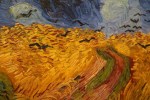
Yesterday I went to the Van Gogh Museum and center for contemporary art. No outstanding stories so I’ll just give you some pictures I took.
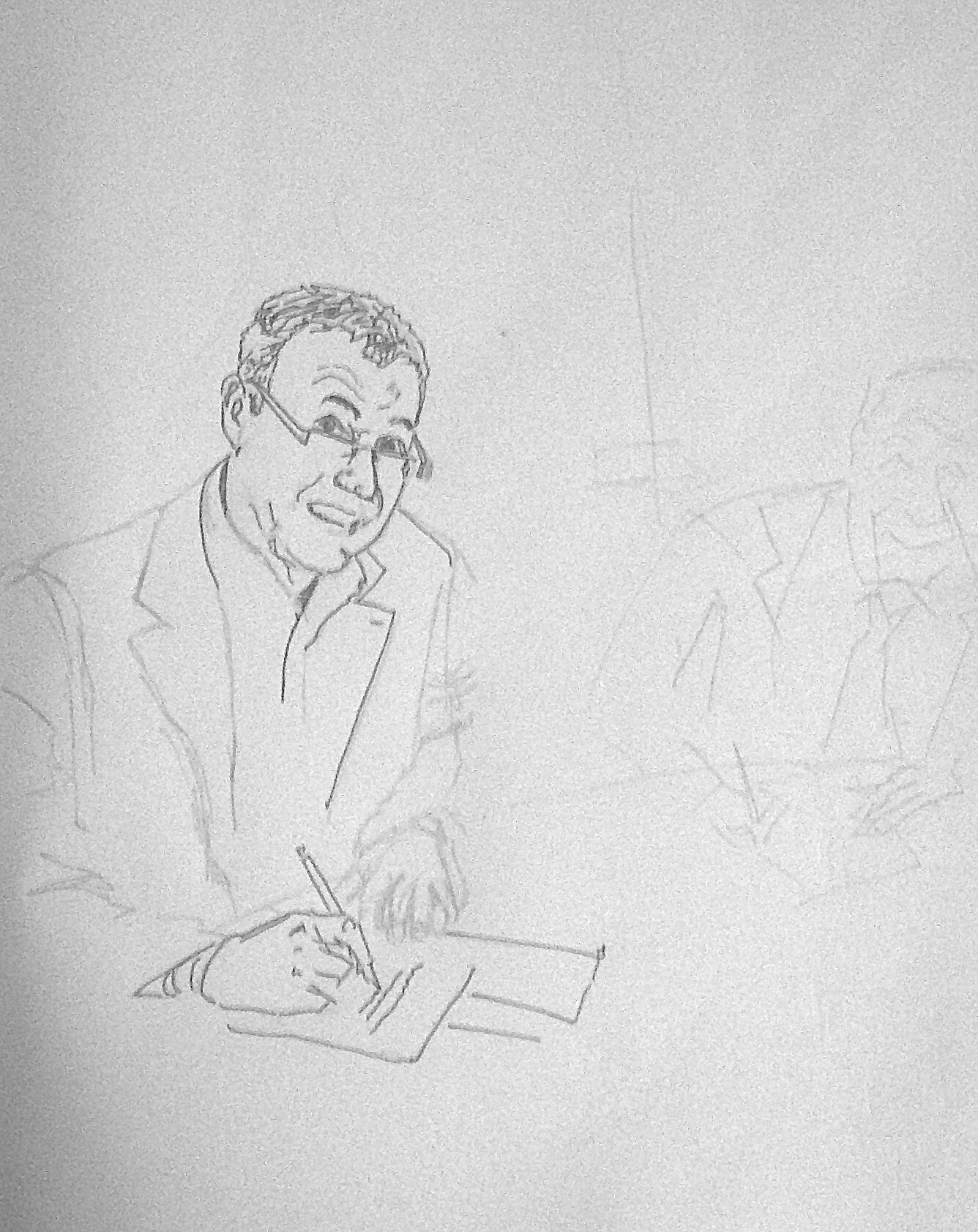
And to wrap up: a drawing of Eddy Moors of the Delta Alliance
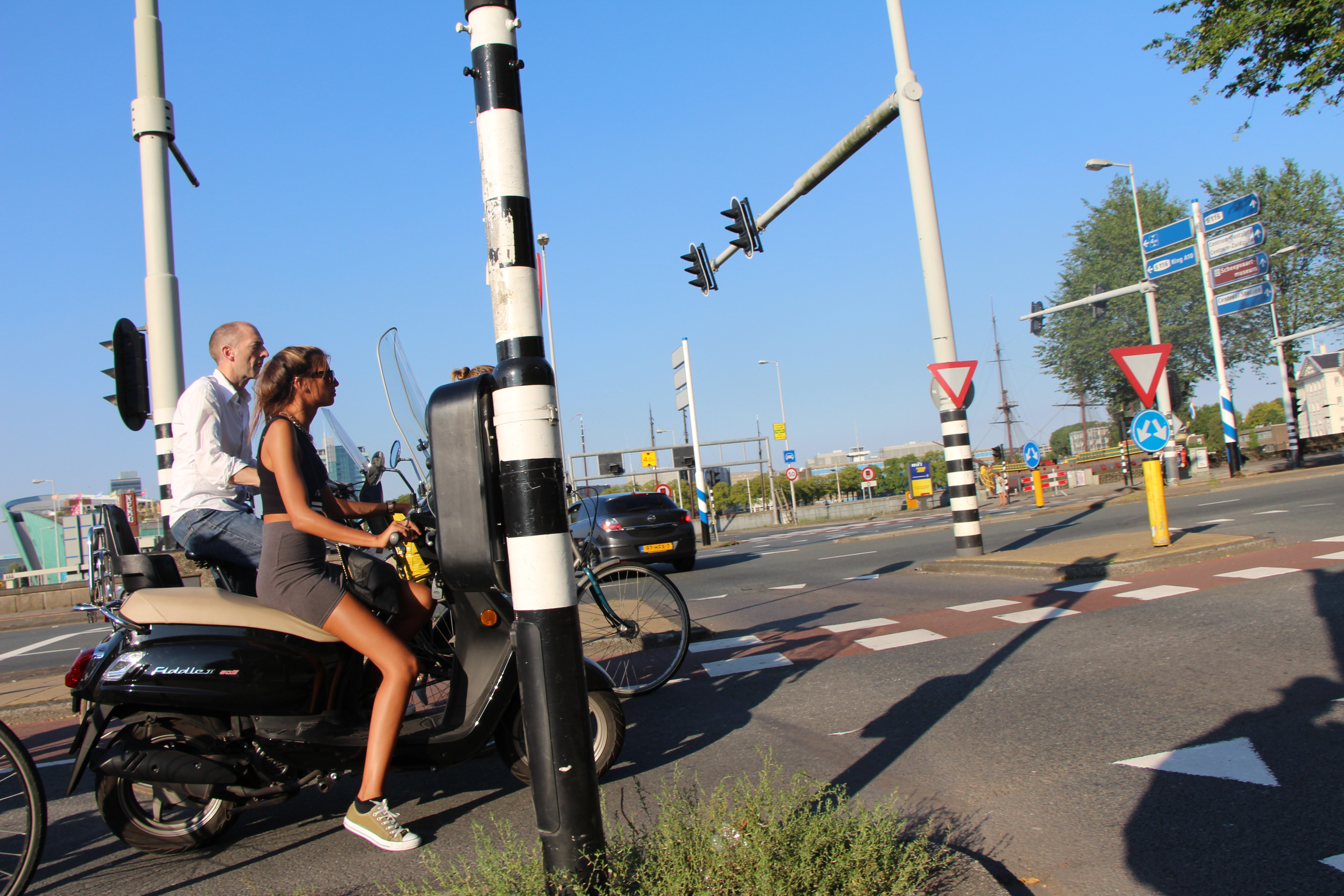
The difference between biking in Amsterdam and biking in Rotterdam is like changing levels in Frogger–the game where you make the frog hop across the 8 lane highway–from ‘beginner’ to ‘you will not make it out alive.’ Bikes clump together like schools of fish, but when the schools cross each other it’s like back in the days of the school yard playing British Bulldog. There so much more to look out for, but also so much more to distract you.
This is very common. Good looking girls on vespas. #thingsilike Notice my shadow on the bottom right.
This picture reminds me of the introduction my advisor, Mr. Tyler, gave to the Goodwin House dorm my first night as a boarding student at Milton Academy. “Hi, I’m Mr. Tyler. I like fast cars, fast bikes, and fast women.” I had no clue what he was talking about as a boyish 14 year old…but he clearly made a lasting impression. #whataguy
On Thursday, I went to Wageningen University to meet Eddy Moors, a hydrologist affiliated with the University. Mr. Moors is part of an organization called the Delta Alliance. The Delta Alliance connects cities all around the world, aiming to improve climate adaptation and resilience. The organization shares research, hosts conferences, and has established wings in San Fransisco, New Orleans, Jakarta, Ho Chi Minh, the Netherlands, Cairo, Dhaka, Shanghai, and Brasilia. The organization is trying to grow and organize access to additional funding. Mr. Moors mentioned the possibility of connecting with the World Bank to work in partnership on projects.
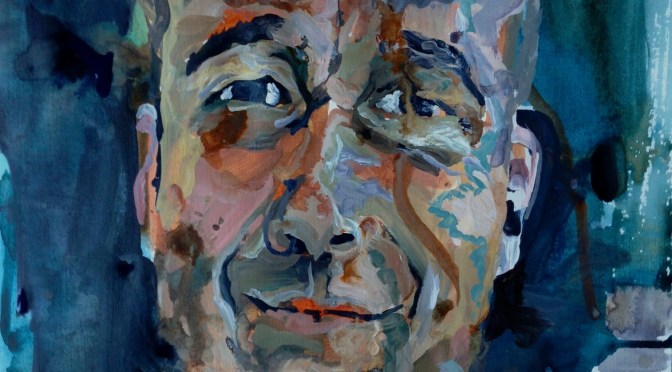
Eddy Moors recommended that I try to use my drawings and paintings to show the advantages of a more watery world. By controlling excess water and safely letting it into areas of cities, you can use its advantages and ecosystem services, Eddy told me. By trying to visualize what future cities in my drawings and paintings, it might be more constructive to show the successes, not waterlogged downtowns and doomsday ‘day after tomorrow’ types of images, he said.
It was satisfying to make a connection within the Delta Alliance, an organization that has a global reach. I got some additional contacts from members of the Knowledge for Climate program in Utrecht and the name of the director of Delta Alliance’s office in Dhaka.
For the next ten days I’m an Amsterdammer.
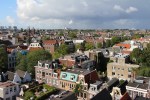
Amsterdam is a very pleasant town. I’m living five minutes outside of the central canal district of the city on a high street that looks like it could be in any part of the world. There is a super market and plenty of restaurants. In a hop skip and a jump, I can get into the gorgeous center of Amsterdam laced with canals, cobblestone streets, and eclectic architecture. The streets are inviting and encourage the pedestrian to wander along. It’s quite funny: you cross a bridge and all of a sudden you leave the ‘non-conventional’ enter the ‘unique-to-Amsterdam’ central canal district as if you’ve passed through the gates of a theme park.
I’m living in a small yoga studio, with a bedroom and a kitchen. Basically I have the whole apartment to myself because yoga only happens a couple times a week.
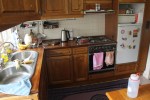
The Kitchen.
My bedroom.
The Balcony.
Downward dog in the studio.
It’s going to rain all week, but that’s perfect because I was planning on hitting the museums anyways. The Rijksmuseum was recently renovated and just re-opened, then there’s supposed to be a great contemporary art museum, and the Van Gogh Museum should be awesome. I also did some research on the music scene here. I’m getting sick of the droll of the overplayed european ‘deep house’ music. I discovered a venue only five minutes from my apartment where three great North American bands are playing for only 10 euros! The Heartless Bastards are playing on Sunday night:
“My father was born in that windmill,” Jos said as he briefly took his hand off the stick shift and pointed across the boggy landscape of the province of North Holland. Now unused, windmills across the Netherlands are reminders of the country’s rich history of land reclamation. Roughly one third of the country lies below sea level; the water was pumped out to create land for agriculture, livestock, towns, and cities. I heard those familiar words, “God created the world, but the Dutch created the Netherlands.”
Essentially, the Dutch build bathtubs by raising the sides of the tub with dikes and levees then pump the water out to create a polder. The windmills were the original pumps. Since the 1700s, they have been replaced by coal-fired and steam plants, and now they are completely powered by electricity. The windmills, although they are no longer functional, are a reminder of how long the Dutch have been at work creating the landscape they take for granted today.
Jos Besteman is the director of legal affairs for the Hollands Noorderkwatier Hoogheemraadschap, one of twenty-five water boards in the Netherlands. A Water Board is a public office in charge of preventing floods, keeping the land dry, and treating wastewater. If your affair falls under any context of ‘water management,’ then water board is in charge.
The water boards were some of the earliest democratic institutions in the world, developed in the Netherlands in the 13th century by councils of farmers and landowners who shared common interests in protecting their land from water. Since then, the original 1,500 water boards have consolidated into 25. The province of North Holland is one of the largest boards. Much of the province used to be a patchwork of lakes, so the Hollands Noorderkwatier Hoogheemraadschap has a lot to monitor.
It is an unusual form of governance, and likely unrepeatable in other part of the world. The boards were established even before the formation of the modern country. If one was set up in another part of the world, there is no simple way to answer the question: who should pay for a specific water defense? It would be difficult to assign the boundaries of a New York City water board and even more troublesome to convince all residents to the benefits of paying a water-management tax. Already in the Netherlands, the public is discontent about the premium they have to pay for flood defense. “We need a storm,” one of Jos’s colleagues told me, “people need to be convinced that this is actually something worth paying for.”
In fact, water management is so engrained into the Dutch landscape that most of the Netherlands doesn’t even consider the benefits the thousands of kilometers of dikes, pumping stations, and storm barriers provide them with. Water is the Dutch condition, but it is so transparent that most cannot even see what it actually does. The Dutch don’t even think about water.
“The local football fields here actually shift, depending on how much water is saturated in the ground below them. The players have no idea.”
Jos Besteman drove me out to the ‘weak point’ of the coastal flood defenses a 30 foot tall dike along the beach. The dike grows out of the landscape like a significant rumple in an otherwise completely flat carpet. The curved hump of compounded clay breaks the force of currents, wind, and waves. It is much stronger than a flat concrete wall would be. The dike stretched for over 60km and is a primary defense from the North Sea.
At first impression, I couldn’t understand why the massive structure, recently renovated in 2007 was the weak point of the defense. It came clearer once I climbed on top of it. To my right was the whitewater of the North Sea and to my left a small farming village, seemingly playing Russian roulette with the forces of nature. “So a little water spilling over the top would be bad, but the real disaster occurs if part of the dike caved in,” I hypothesized.
“The town has relocated about 5 times in its history,” I was told. “The ruins of the old town are lying right there under the sea.”
“When’s the next move?”
“At this point, there is no where to go. These people will stay and fight the water, or be swept away with it.” For now, the town needs to rely on the computer systems, geologic modeling, knowledge and insight of the water board and the good faith in the firm protection of the dike. It’s not just the proximal towns relying on this construction though.
“The whole system of dikes and levees is so connected throughout the country. Everything affects something else. Engineered constructions in North Holland are what keep Amsterdam, 80km to the south protected from the sea.”
I thought of the works of Rembrandt, Van Gogh, Vermeer, and other Dutch masters, the churches, museums, and bridges whose longevity is dependent on the storm defense I was standing on. Then I thought about the masses living in Amsterdam—the commotion in Centraal Station, the buzz of the cyclists alongside the canals, and the stoned teenage tourists wandering through the city corridors, all completely oblivious to this impressive structure. It is just one impressive piece of the network that keeps the country dry.
Yet still, this dike is a concern for the water board. It was the weak point of the whole coastal defense. The dike was built as a substitute for sand dunes in the only stretch of coast where sand dunes do not exist naturally. When I first noticed the sand dunes in the hazy horizon, I finally understood why there were perceived shortcomings of the dike defense.
In contrast to the expansive fields that could be likened to the plains of the Midwest, the dunes looked mountainous. During my six weeks in the Netherlands, I have become well adjusted to living on or below sea level, and playing rugby on the unofficial lowest rugby pitch in the world. My knees began to shake as I climbed the 52-meter dunes, the tallest topography of North Holland. The dunes stretch inland 5km from the coast. “This is the safest place in the Netherlands,” Jos told me, “this is where I’d come if the dikes break.”
“You wouldn’t retreat to Switzerland?” I asked, thinking what I would do in the situation.
Jos smiled, as if I had asked a silly childish question. He thought for a second then softly remarked, “My family can be traced back 500 years to tribes that lived on this land. They say my great-great-great-great-way-back-great grandfather was one of the initial investors on one of the earliest polders (reclaimed land). My cousins are farmers here. I am one of my only friends who haven’t left this area. I married a girl whose family has been on this land for 200 years and mine has been around for 500.”
Jos had grown up in this region, commuted to the University of Amsterdam to study and never left. He told me, “If you ask anybody working at the waterschap why they are working here, the vast majority will answer ‘because I love this land and I want to work to protect it.’”
For the Dutch, protecting their land from the looming threats of the water is a source of national pride and personal pride. It is their country, the land, and their history at stake. The idea is engrained into the motto of the Royal Family, “Je Maintiendrai.”
I will maintain.
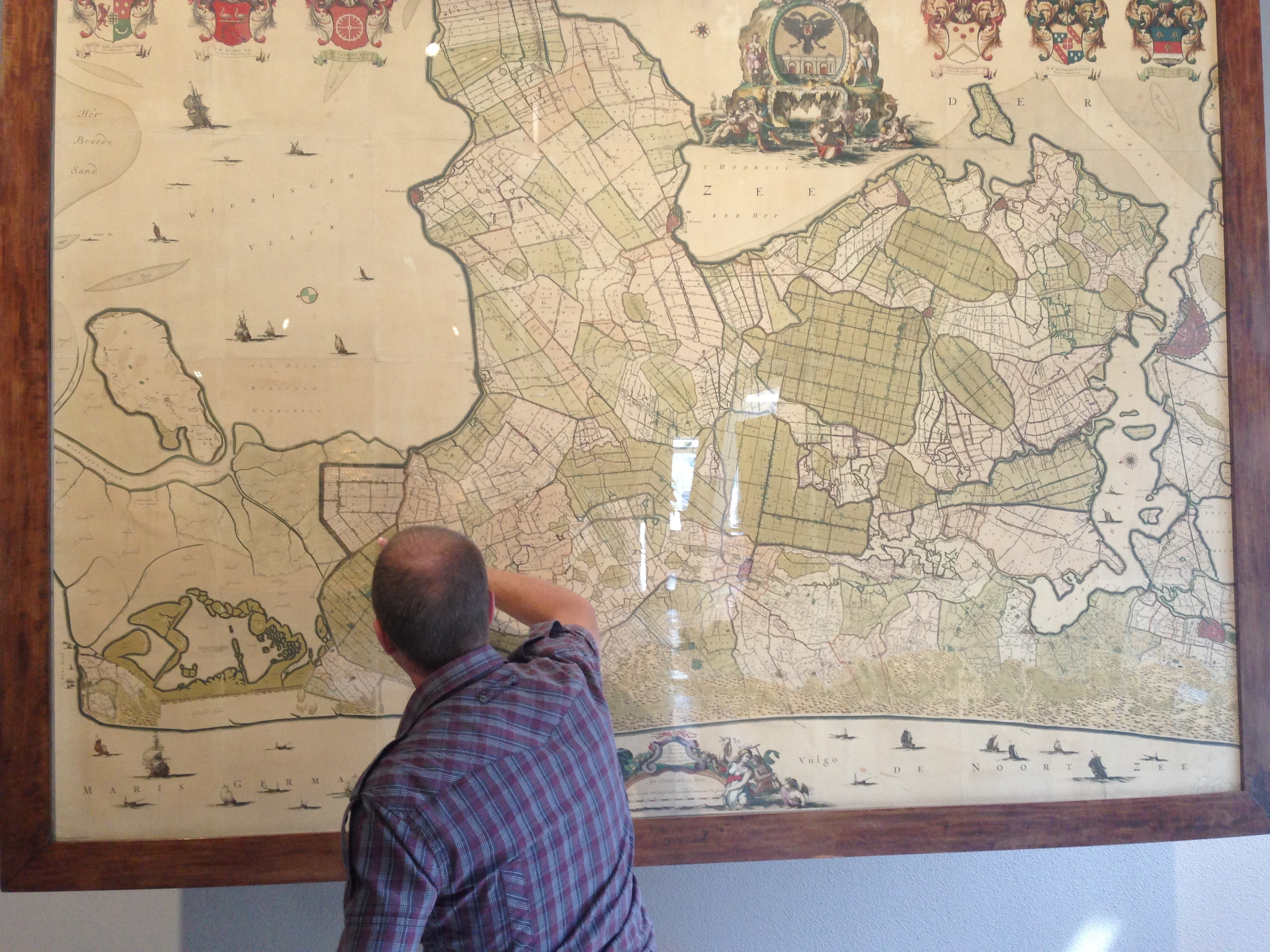
Jos explains a map from the 17th century. The dark green areas are fields reclaimed from lakes. The stretch of coast under Jos’s elbow to the right are the sand dunes. The white rectangle above his left shoulder is the dune-less stretch where there is a man-made dike discussed above.
The dunes look a lot like the Cape Cod National Seashore in Truro
These sand dunes lie 52 m above Amsterdam Sea Level (the Greenwhich Mean Time of Dutch sealevels)
The water board’s coat of arms.
Here Jos Besteman explains the evacuation strategy of North Holland:
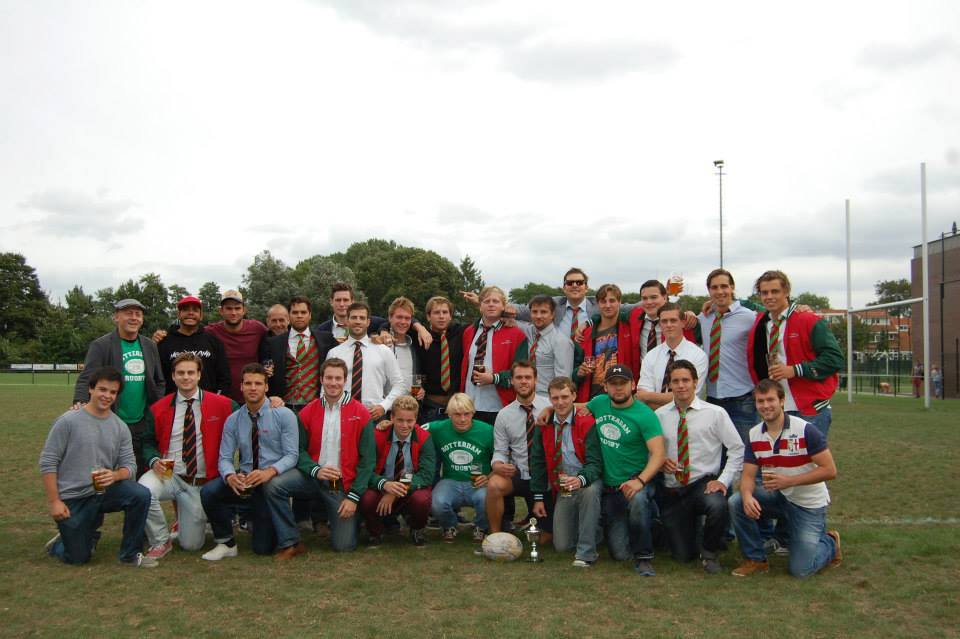
Sunday RSRC won the Rotterdam cup, proving that we’re the best team in town. Competition in the regular season begins this Sunday, but USA Rugby hasn’t cleared me to transfer my eligibility over here yet…I could play in the pre-season matches but I don’t want to get the team in trouble for playing without being registered. Huge bummer.
Some of the guys on the team started calling me ‘American.’ It reminds me of the way they call Gladiator ‘Spaniard.’
In many ways, I feel like I’m representing the entire USA rugby community in front of these guys. I’m probably the one and only American rugby player this lot will ever meet so I gotta represent. #murica
On Monday, I spent the day in the Hague and the neighboring beach community, Scheveningen. Scheveningen has been torturing me since I got here. It is impossible to say unless you are Dutch and it’s been to the absolute delight of many many Dutch students hearing me butcher the pronunciation time after time after time…after time. Many conversations after meeting people will go, “Ohhh you’re American, where are you from?” “A small town north of Boston” “You don’t have a Boston accent but you definitely sound American” “Try saying this Dutch word, Schhkkkkleavlingah” “Shavelinger” “No. Schckkkeaveleveingah, with a ckkkk” “Okay Shavelinger” “Not quite good effort, though” (as they snicker and walk away).
I’ve gotten myself into that scenario about 15 times in the past two days. The hardest part was asking for directions to Scheveningen. I ended up just lowering my head and pointing on a map, acknowledging that I was a defeated doofus.
My hopes for a thriving career in espionage came to a startling halt when I heard that Scheveningen was used as a password in WW2 to identify German spies. The ‘chkkk’ sound is a real head-scratcher.
I met a man named Pier Vellinga for lunch in the Hague. He treated me to a delicious club sandwich and a coffee. Professor Vellinga is an expert on the impacts of Climate Change and invests in research that aims to climate proof cities. He advises Venice on flood prevention and water management and works with Ho Chi Minh City’s community based adaptation strategies. Pier was trained as an engineer at Delft University and now is deeply involved in the Knowledge for Climate program. See here. It was very nice of him to meet me–every day he travels around to at least two major Dutch cities for meetings. A very busy guy, but he was a delight to talk to. He speaks in a very calm, meditative tone and has a lot to say.
Professor Vellinga advised me to keep a look out for certain characteristics of the cities that I travel to. For example, are the cities using large scale adaptation strategies or small scale projects at community and household scales? What kind governance exists in each country? Is water management and flood control public or private? He hammered down the point that there is a huge return on investments in flood defense infrastructure. The cost of protection is usually far lower than the benefits of sustaining the economy, ecology, and populations of a region. But of course this is more-so true for large cities with proper economic activity than small rural towns.
I was also advised on some ways to collect and organize all the information I encounter over the year. Professor Vellinga also had some useful career advice and suggestions for graduate school.
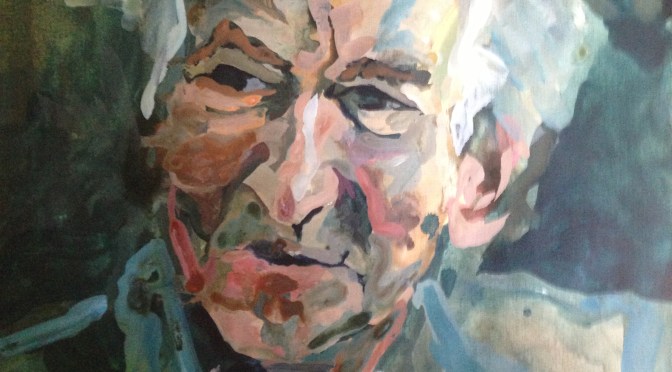
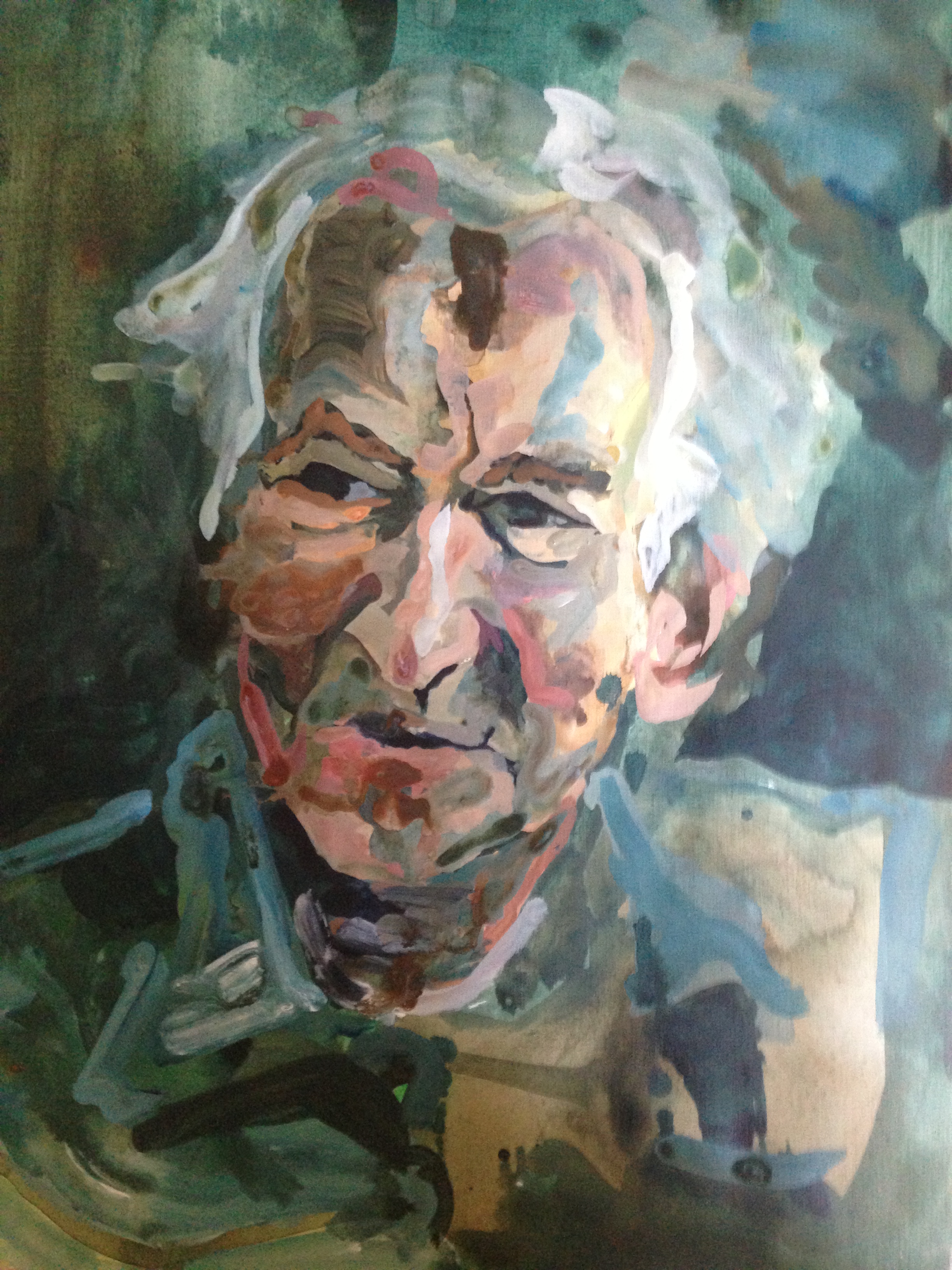
This was sort of a break through painting for me. I’m using acrylic paint so I’d load up the pigment with a lot of water and let the colors blend, drip, and flow letting the water take its own course. It was then a wrestling match of trying to control where the water went and shape the painting into the form I wanted. It’s kind of a cheesy concept, but to me it seems logical. And hey, I like cheese. If you look closely you can see areas where the paint makes shapes that look like rivers and deltas from a satellite view.
Here are some pictures from the Hague. The Hague is where the seat of government is. There are royal palaces, houses of parliament, national defense offices and so on. While Rotterdam was bombed really badly in WW2, the Hague retains its historic character and you see nice gothic buildings built into the urban fabric.
The old, the new, and the newly renovated.
This little bird is working hard to become the feather in King WIllem II’s cap.
#allgoldeverythang
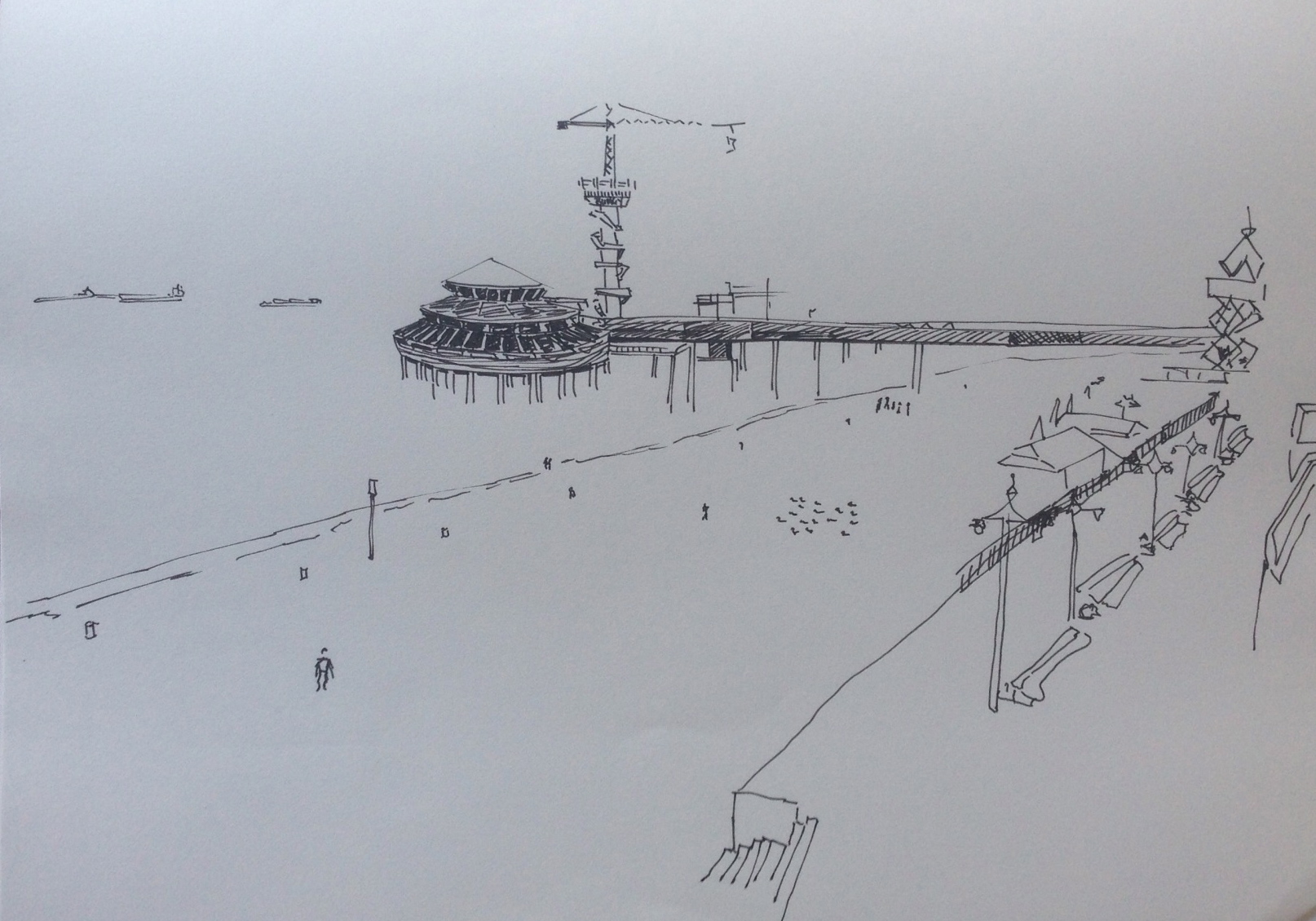
Scheveningen is a suburb of the Hague and a beach town. It was built on top of sand dunes, natural storm surge defenses. The town has built a multi-functional sea wall defense. The sea wall is raised about two stories at the end of about 100 meters of sand and the wall is programmed with a beach boulevard, shops, and store-fronts that unfortunately make Scheveningen look more like Mytle Beach or the Jersey Shore than a picturesque beach town.
The beach, even on a grey windy day was filled with recreation. There were kite-surfers, surfers, kite-flyers, and families strolling the boulevard. A lot of the restaurants and beach clubs were closed down for the season, but it was cool to see. I will likely head back out there sometime this month with a surfboard, just to say I surfed–well, tried to surf–in the North Sea.
‘
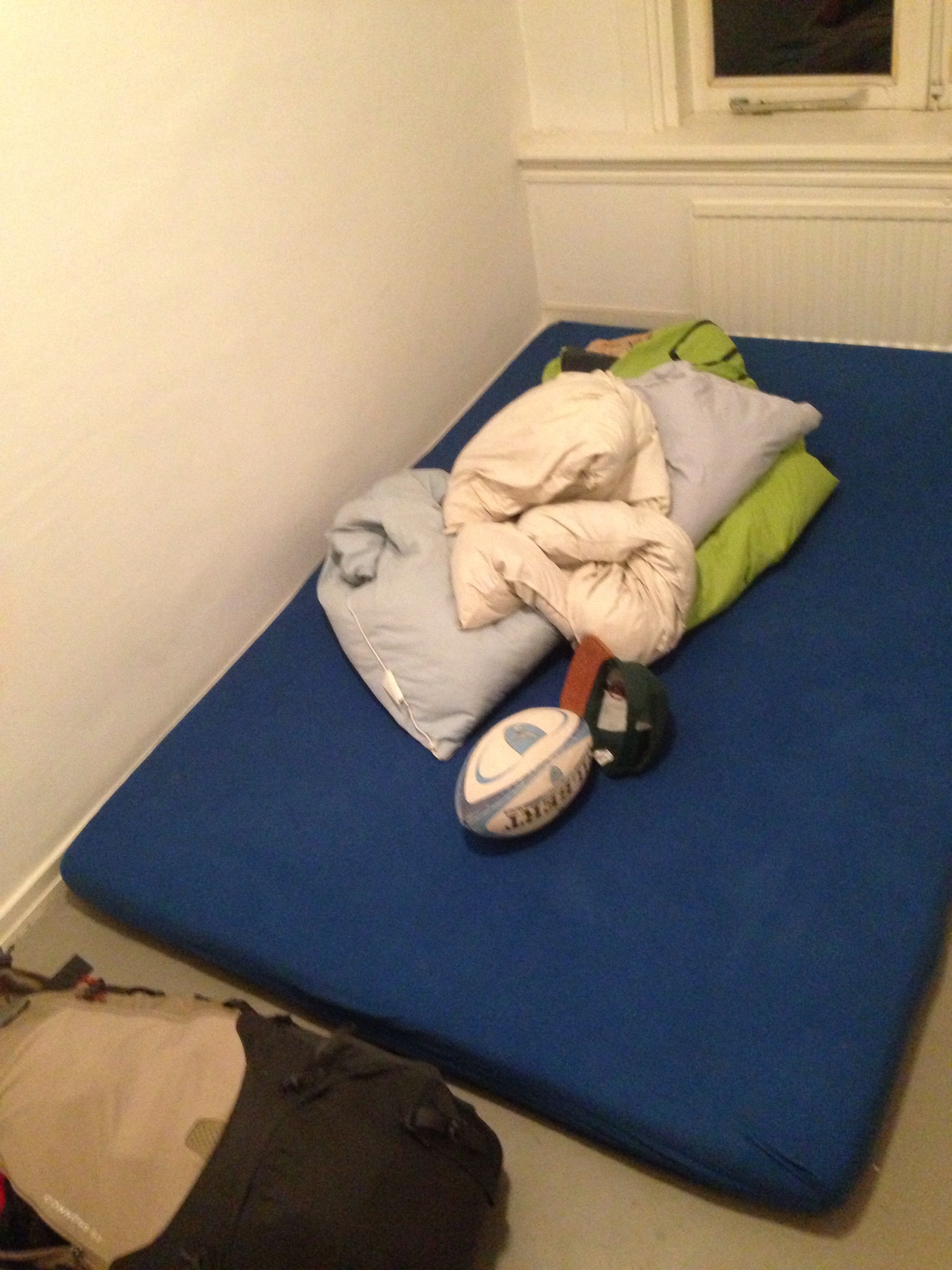
The past three nights I’ve been staying with some of the Rugby guys: Mikey, the captain of the team, a resident of Sheffield, England, and a chemical engineer for body wash products; Archie, a fellow Scotsman from Glasgow and Jappie, a native Nedelander. I’m crashing in their so called closet room. It’s a mattress on the floor, a pillow, and a rugby ball. #feelslikehome.
Today I’m heading up to Amsterdam. I’m going to crash on the couch of Sierra Frisbee’s place. Sierra is a Bowdoin junior studying abroad in A’dam.
Tomorrow I’m meeting people who work for the Delta Alliance, an organization with the mission of improving the resilience of the World’s delta cities. I move into the yoga studio on Sunday.
I took a huge risk in July when I paid forward one month’s rent in an unknown city for an unknown apartment with unknown roommates. I got as lucky as lucky ducks get.
It’s been a wonderful stay in a beautiful apartment overlooking the Maas River. 78 Maaskade quickly became home and I made a few Dutch friends for life.
Berend took off today to live in Madrid for 6 months. He left me with an early birthday present, which I model here: click. Roffa is, in Berend’s own words, “the gangster name for Rotterdam that only gangsters use.” I’m glad to be awarded this token of appreciation and be deemed cool enough to represent Rotterdam as the city’s only American OG. I promised to wear it all over the streets of Amsterdam and do the ‘Ben Bruce’ dance whenever someone indicates their disgust and outrage at my sweatshirt choice. (For the #newbs: the legendary Ben Bruce move is when you put both hands on your head, bite your tongue, and move your hips around with feet still, obviously). The dance move is proven to turn water into wine.
All in all, it has been a brilliant stay and it’s sad to leave my Rotterdam home. But, nothing lasts forever and I’m glad to have great memories to look back on.
I couldn’t have written a better day today. I painted, hit the market (20 kiwis for 4 euros–yes!), skateboarded to get some coffee, and joined Marco with some other Erasmus students for a delicious home cooked meal of Nasi, a peanut-buttery Indonesian rice dish.
Playing in a rugby tournament tomorrow, then I’m crashing for the night at a teammates place. On to the Hague, Amsterdam, and adventures beyond. It’s been a while since I’ve put on my backpack.
Last night, I went out with a whole bunch of students who are doing an International Business Management masters program at Erasmus. We all got together at a house nearby for drinks before going to a club. It was pretty amazing to be in a room with students from Italy, Hungary, Greece, Poland, Spain, Portugal, the Netherlands, Sweden, Denmark, Norway, Czech Republic, and so on. If you think about it, it’s geographically no different from sitting in a class at Bowdoin with kids from California, Colorado, Arizona, Florida, and so on. But the cultural differences within the small geographic area of Europe are so much more apparent than in the U.S. Very cool to witness.
As for now, going to watch a movie called ‘Mud’ with Marco, pack, then get some sleep before rugby time.
Damn it feels good to be a gansta.
It’s a bummer sharing the only the photos of the paintings rather than the actual artifacts with you. I always get disappointed about how they look as photographs, but hey I’ll mail them to Hanover at some point so if you’re super eager you can drive on up and stay with my parents for a night!
Today I had a big plan to take the waterbus up the river to explore a city called Dordrecht. I got to the station, waited for about five minutes and then proceeded to get poured on in a flash rainfall. The sky looked grey as far as I could see so I figured it would be a rainy day. I retreated back to the house and decided to spend the day working on a painting. Ironically, 40 minutes after I got back to the house and started working, the sun came out and it turned into a beautiful day.
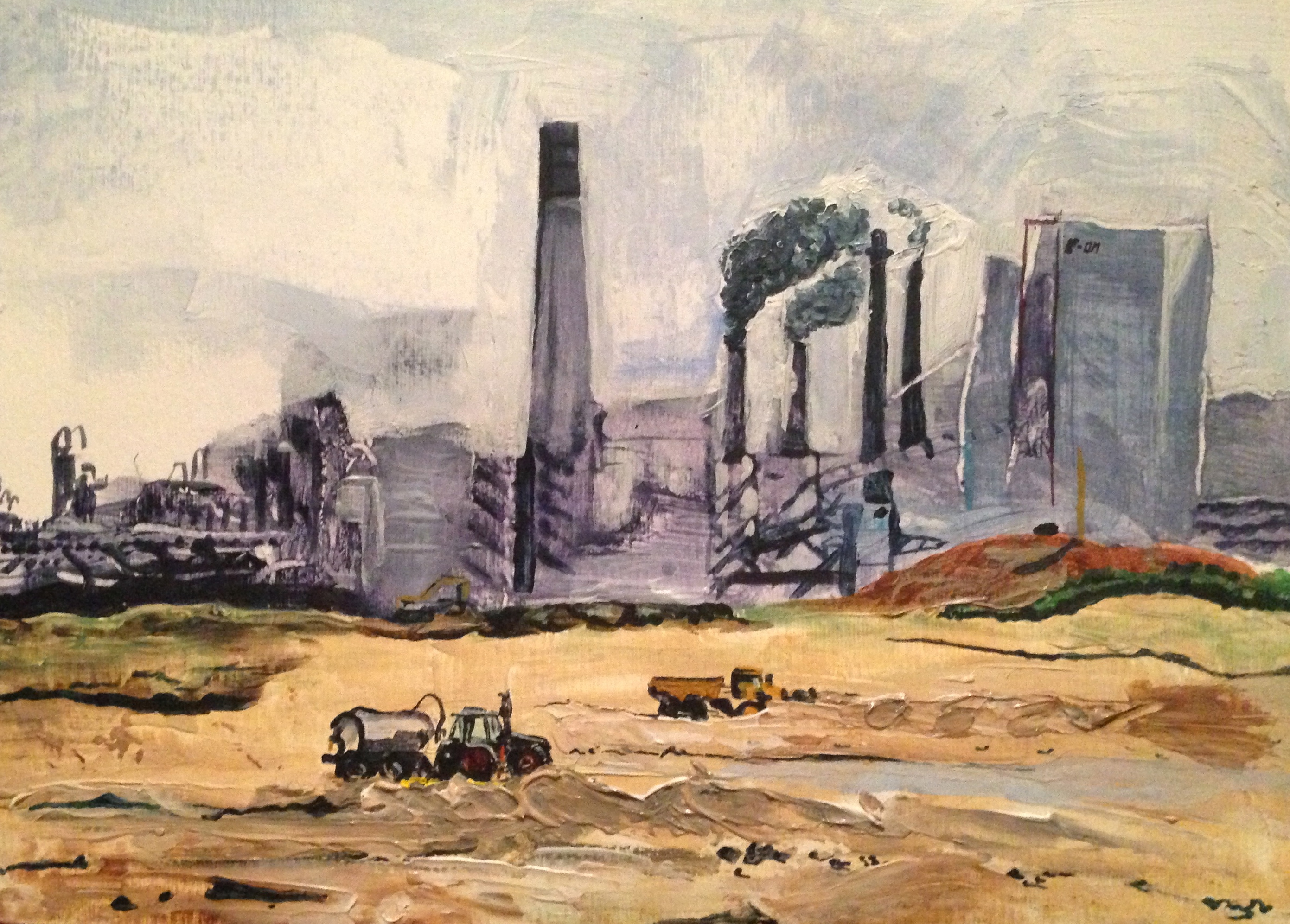
The Control of Nature
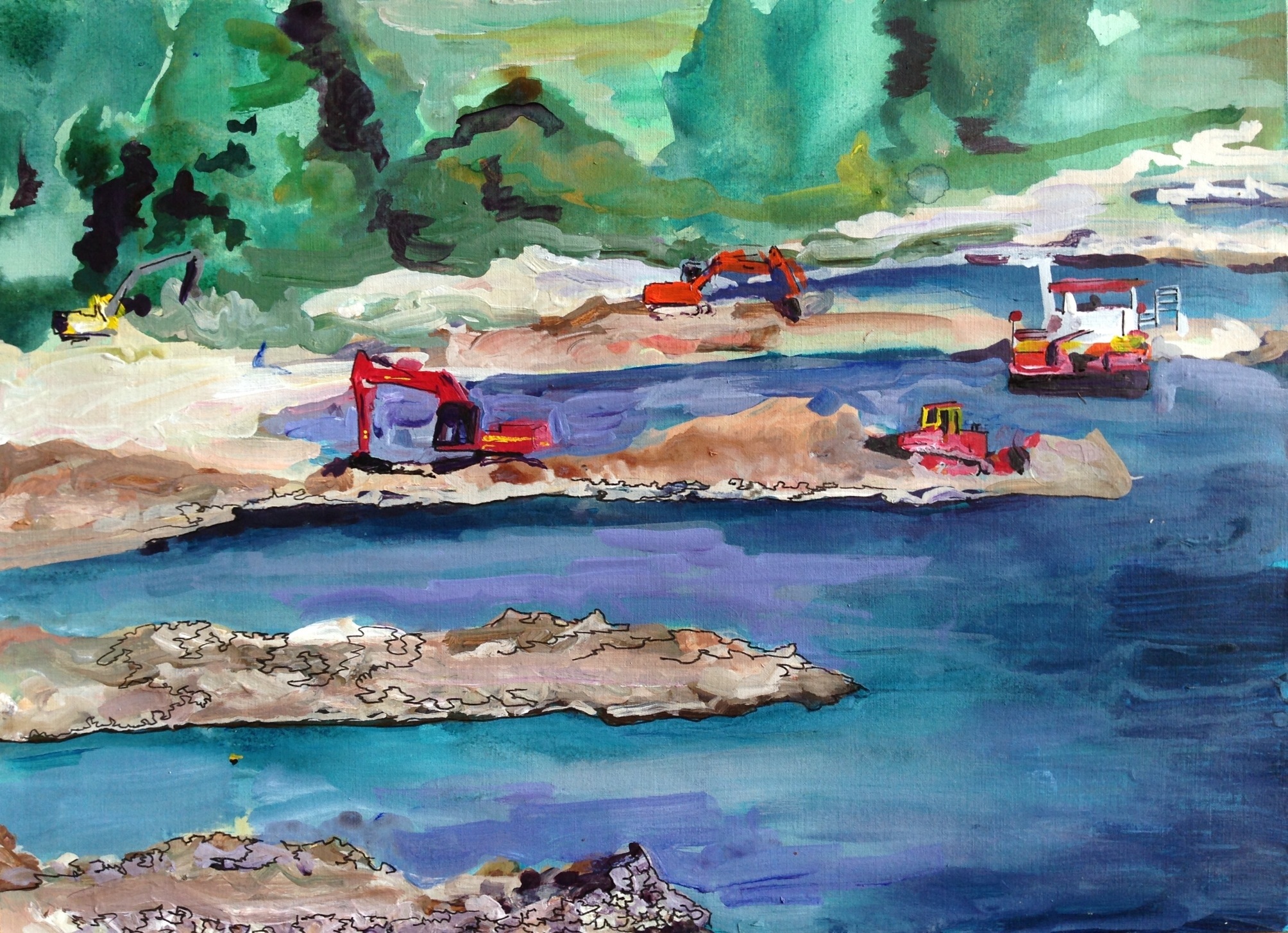
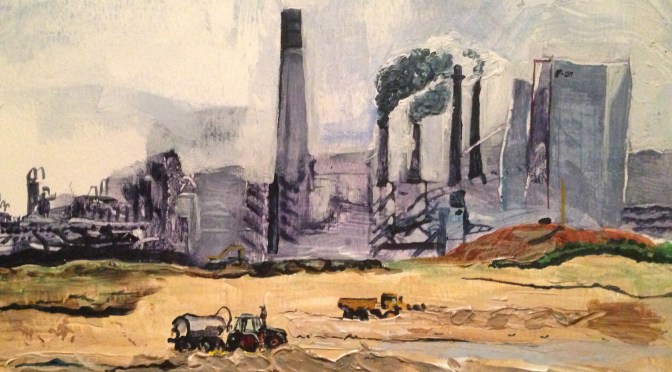
This is a painting of Maasvlakte 2, the man made land at the end of the Port of Rotterdam that is the same size as Rotterdam’s airport. It’s built from sand pumped up from the bed of the North Sea. On the horizon are power plants and oil refineries that power the daily requirements of the port.
This afternoon I walked over to the art store to pick up some more white paint. Through the shelves I heard a familiar American accent (much more rare in Rotterdam than Amsterdam, I suppose) and turned the corner to investigate. I met a woman named Renee van der Stelt who is an artist in residence north of Rotterdam. She is a drawing professor in Baltimore and had some great suggestions about how to visualize and diagram all the conceptual ideas I’ve got rolling around in my head. Check out her website here. It was refreshing to have a brief chat with someone from the East Coast.
Played a rugby game last night! 19-5 win.
Next week, I’m turning into a little bit more of a nomad. I’m meeting people all over the Netherlands so going to see a lot of the country and hopefully get some awesome insight from big shots in the professional world of water management.
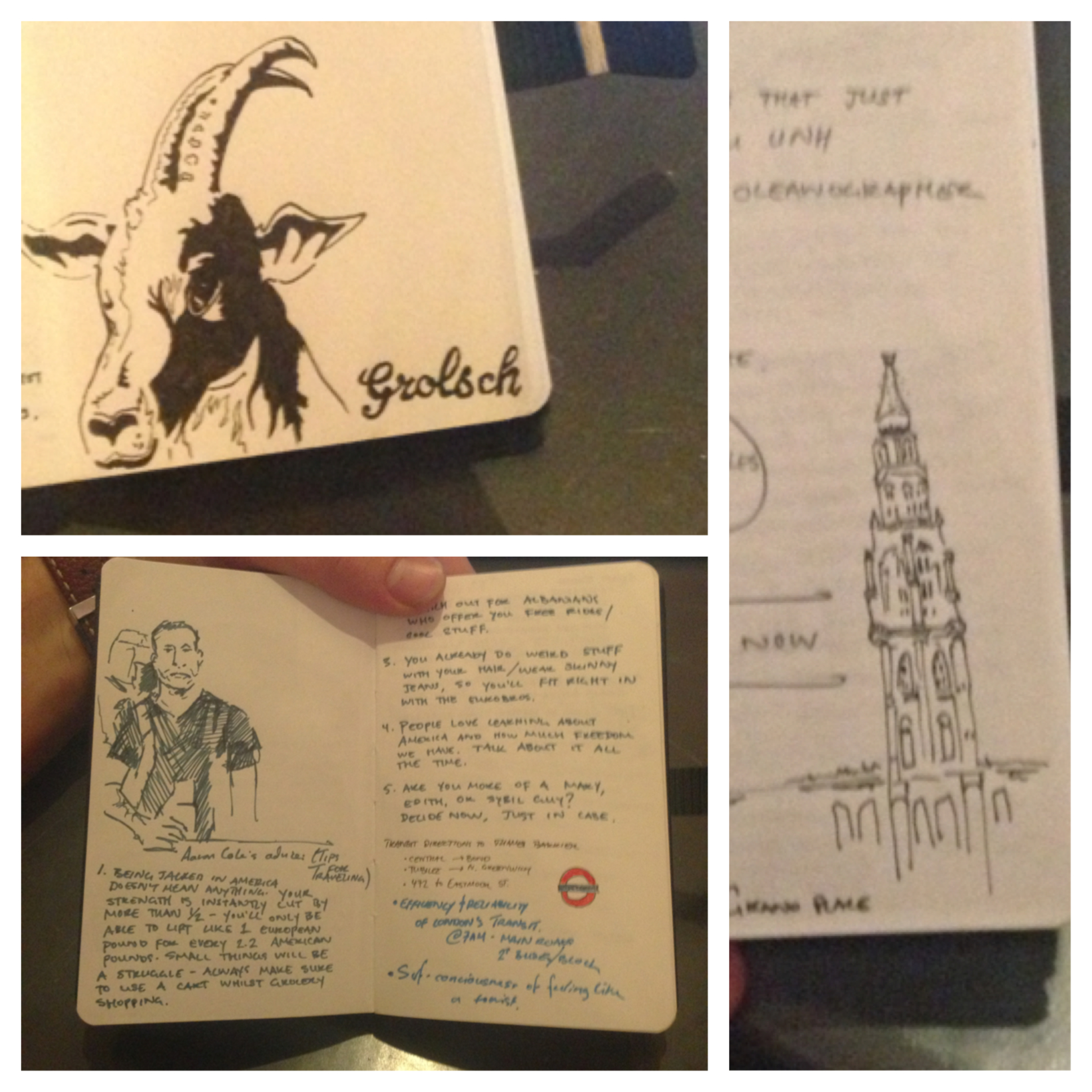
As well as my sketchbook, I keep a journal with super small pages. I actually have a lot more fun drawing in that journal than in the big sketchbook. It’s cool integrating drawings into the writing. Whereas the big sketchbook had so much intimidating white space that I feel obligated to fill up. I like the small pages.
I have another bigger painting in progress. Hopefully I’ll get that to you soon.
You know you’re concerned about sticking to a budget when breakfast involves scavenging the fridge to find suitable ingredients to liquify in the blender. This morning I was lucky enough to make a banana-avocado smoothie but it’s been worse. Once I had to resort to partly moldy strawberries. According to Sir Alexander Fleming, mold is penicillin so it can’t be bad for me. All in all, blenders are probably on my list of favorite kitchen appliances, after the mandoline and donkey shaped cookie cutters.
It was Berend’s 22nd birthday yesterday so I got him the best present he could have imagined. I model the gift below: 1. It’s camo #nuffsaid
2. He recently got new low-cut chuck taylors with some camo print on them so now he can match.
3. He already wears a Chicago White Sox hat, even though he didn’t know what the White Sox were until I got here.
4. Berend’s leaving to study abroad in Madrid…when he wears the shoes and hat together there is a 95% certainty that no spanish girls will talk to him. He’s had a serious girlfriend for about 5 years so I’m just trying to keep them together. #savioroflove.
5. Chicago!
Yesterday, I went on an extensive full day harbor tour. 10am-5pm. That’s a long ass time on a boat, but there was some fantastic opportunities for people watching. I saw some mind-blowing harbor infrastructure including some of the largest container ships in the world.
My favorite people on the boat were two english men that got as excited by tracking and recording cargo ships as an ornithologist from the prairies of North Dakota would be about being in the jungle with birds of paradise. They both carried binoculars. One guy’s binos had orange lenses which made me pretty jealous. They would scan all corners of the harbor and frantically write down the names of the boats they saw. Both men were hovering around 50, but at times they would get more excited than a school kids at the sound of an ice-cream truck. They bellowed their spottings as if they had made a nobel prize winning discovery.
The other people that baffled me were two kids, a boyfriend and a girlfriend between 14-16 that would ‘sneak away’ from the parents to go make out and smoke cigarettes. First of all, kids, the boats not that big and nobody wants to see your gross awkward-phase romance. Second, smoking kills. Get it together.
The captain gave a guided tour of the harbor, which I’m sure was brilliantly interesting and informative. I would have listened but it was entirely in Dutch. I wrote down some of the key words and did some research on the Port of Rotterdam site:
The harbor and its industrial sites stretch 40km
34,000 sea going vessels and 100,000 barges visit the harbor annually
90,000 people work in the harbor
Rotterdam is home of the EJT (European Juice Terminal)–16 thousand-ton stainless steel tanks for Brazilian orange juice concentrate storage.
The harbor has two man-made ports constructed by building an enclosing dike and filling it in with sand in the North Sea. The first was built in the 1960’s and the other was just completed this year. They are called Maasvlakte 1 and Maasvlakte 2.
Mississippihaven in Maasvlakte 1 is the largest dry bulk terminal in europe. 20 million tons of coal and 13 million tons of iron ore. 140,000 tons can be unloaded/day.
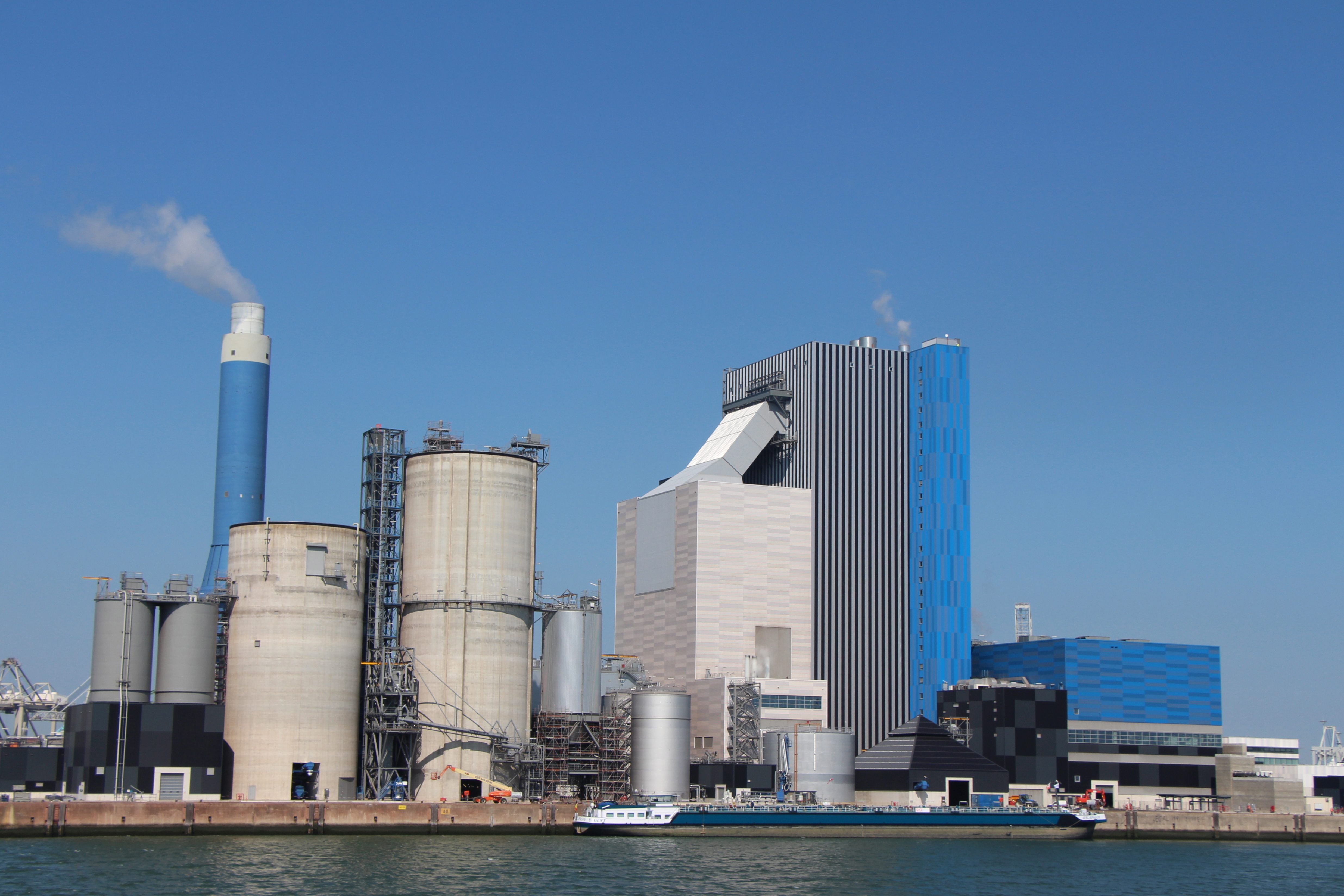
Below is the world’s most modern coal and biomass plant. It has a capacity of 800MW.
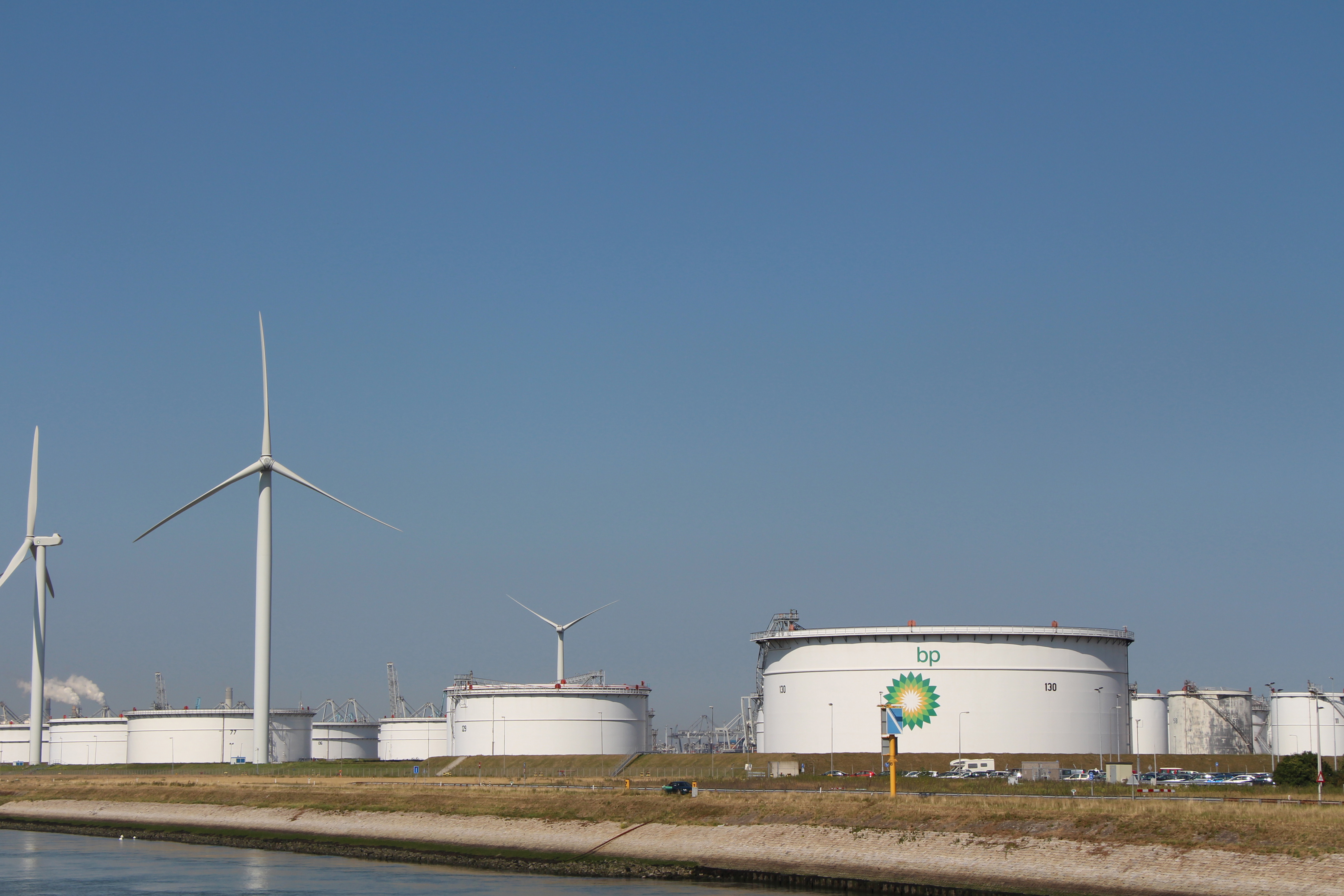
The BP Refinery Rotterdam is one of Europe’s largest with a processing capacity of 63,500m^3 or 400,000 vats of crude oil a day.
There were hundreds of silos. The camera cannot capture the vastness.
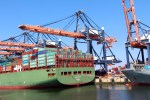
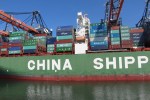
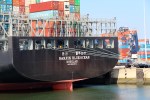
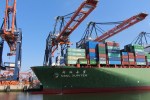
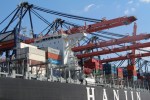
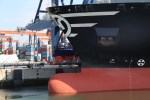
The Euromax terminal is one of the most advanced and environmentally friendly container terminals worldwide. The automated terminal houses ships from the ‘Green Alliance’–a partnership between Cosco, “K” Line, Yan Ming and Hanjin. Look for clues in the photos that give a sense of scale. Rarely can you see something that we are used to…one of the photos has a car in it which can give you an idea.
The Maasvlakte 2, just completed this year makes the harbor about 20% bigger but the first container ships won’t be unloaded there until 2014. Right now it just looks like a desert or a man-made island from Dubai. It cost about 2.8 billion euros to construct.
This will eventually become…
this
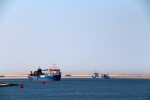
This boats pump sand from the North Sea into the constructed dikes to fill the land.
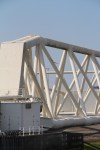
The cruise took me back past the Maeslant Barrier.

















































 Cities@Sea